
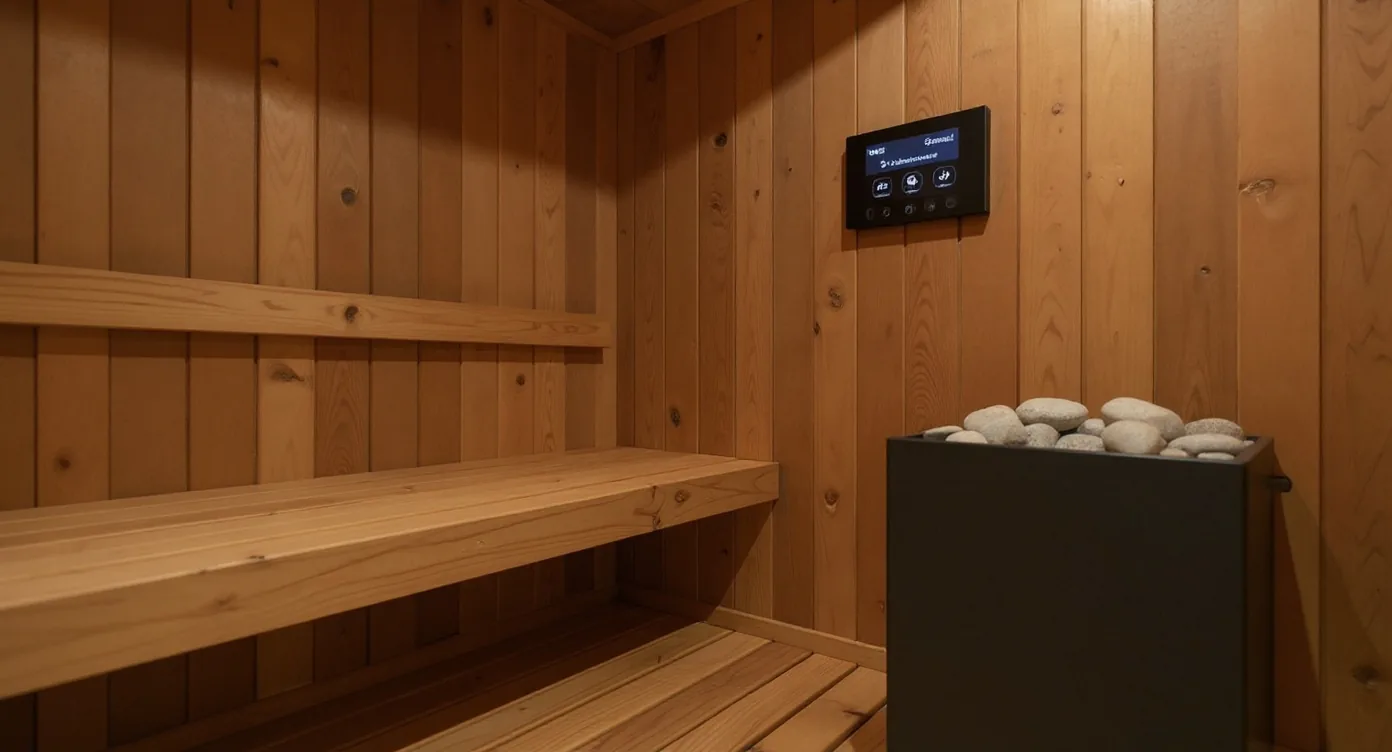
This guide compares Finnish, BIO and infrared as project options. It does not organise a medical weekly protocol or rank modes by a claimed physiological effect.
The decision starts with the people using the room, preferred heat, utilities and maintenance. A multi-mode configuration is worth the added complexity only if the different modes will actually be used.
Step 01Three modes, three technical experiences
Finnish, BIO and infrared sauna are not a hierarchy from weak to strong. They differ in heat source, humidity control, room feel and installation requirements.
- Finnish sauna — heater and hot stones, dry air with intermittent löyly
- BIO sauna — compatible Combi heater, lower temperature and controlled higher humidity
- Infrared sauna — IR emitters aimed at the body position, without steam generation
A multi-mode configuration only makes sense when the user genuinely wants several different experiences. One well-chosen mode is not an incomplete solution.
Step 02One mode per session as a practical default
Changing mode requires the room and equipment to stabilise at different temperature and humidity settings. The clearest way to use the sauna is therefore to choose one mode for each session.
If the manufacturer of the selected equipment permits another sequence, it is confirmed during design and handover. KUBIQ does not invent a universal physiological protocol beyond the installed system’s instructions.
Step 03A weekly rhythm is not a factory setting
There is no single schedule suitable for everyone. Frequency depends on setting intensity, experience, health, other activities and personal tolerance.
A more useful framework is to choose the desired experience before each use: classic löyly, gentler humid heat or dry IR heat. Rest and stopping at discomfort apply to every mode.
Step 04Season changes the context, not the rules
Outdoor temperature and humidity affect comfort, warm-up time, cooling afterwards and fluid needs. These are practical adjustments to space and equipment, not proof that one mode is medically better in a given season.
Step 05How to choose a mode today
Selection starts with the desired experience and available time, then checks the equipment and the user’s condition. A mode is not a therapy label or a promised outcome.
Step 06Four common mistakes
1. Buying multi-mode without a clear reason. More functions are not automatically better when only one is used in practice.
2. Turning an illustrative schedule into a universal protocol. Session count and spacing cannot be set without user context.
3. Ignoring instructions for the actual equipment. A heater, Combi system and IR emitters do not share the same controls and maintenance needs.
4. Confusing preference with proven benefit. Feeling better in one mode does not prove the same outcome for another person.
Step 07What if you have only one mode
One mode can be a complete solution when it fits the space, utilities and intended use. A project partner should help select what will actually be used, not enlarge the specification without a reason.
Step 08Next step
The choice between one or several modes is made before equipment is specified. KUBIQ first checks users, room, utilities and maintenance; it does not increase the configuration simply because it is technically possible.