
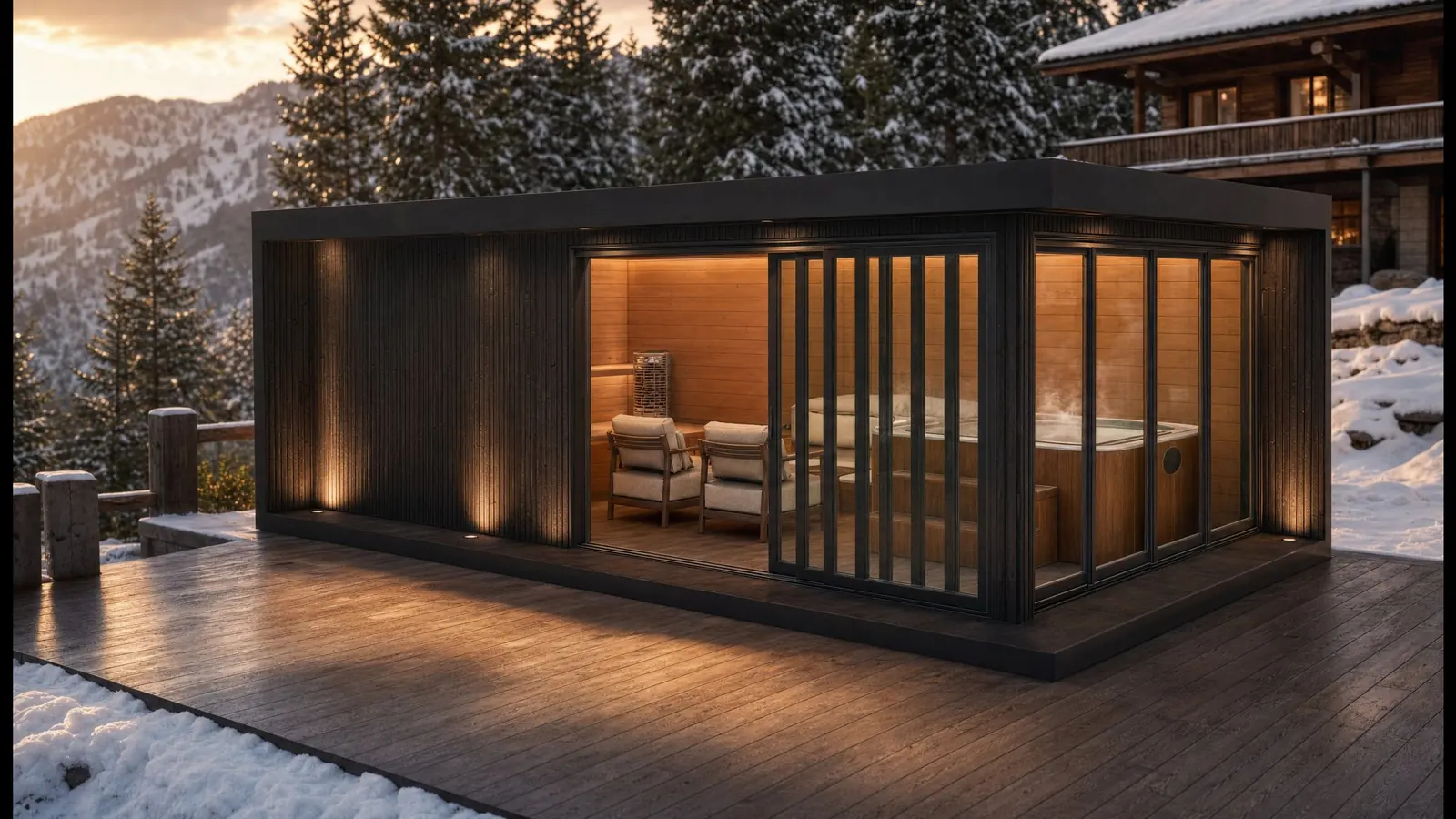
“Add a sauna and a jacuzzi” sounds like a finished decision. In practice, this is where most projects go wrong — not because the idea is bad, but because wellness is understood as equipment, not as an experience the guest comes to live through.
A guest looking for wellness in a holiday home already has a ritual they practise at home — sauna, cold plunge, quiet. When choosing where to stay, they are not asking “does it have a sauna”, but “can I do here what I normally do”. The difference between those two is the difference between a property that gets booked and a property that is remembered.
This guide does not sell equipment. It walks through six decisions — from the guest, through the build, to the business effect — in the order in which they are actually made.
Step 01Who is the guest looking for wellness
Before deciding what to build, it is worth understanding who is looking for it. Because that profile explains why wellness changes the economics of the property, not just the listing.
The guest comes from markets where wellness is part of everyday life, not a luxury. The main foreign markets for continental Croatia are Germany, Austria, Slovenia, Poland and Czechia (HTZ/eVisitor, 2024–2025). This is not accidentally relevant: Austrians are global leaders in wellness spending per capita — wellness accounts for around 9% of Austrian GDP (Global Wellness Institute, 2024), while Germany has more than 2,000 public sauna facilities and around 1.7 million households with a private sauna (Deutscher Sauna-Bund, 2024).
For that type of guest, a sauna is not an attraction — it is something they also use at home. When they travel, they look for a property that allows them to do that. When they find it, that property goes to the top of the list, and price moves lower on the priority list.
That guest spends more and chooses by substance. Wellness tourists account for around 8% of trips, but close to 18% of tourism spending — roughly 2.3× more than the average guest (GWI Global Wellness Economy Monitor, 2025).
Continental Croatia is now moving into that market. In 2024, Krapina-Zagorje County recorded more foreign than domestic arrivals for the first time and exceeded 400,000 overnight stays, with further growth in 2025 (TZ KZŽ / HTZ eVisitor). This is a structural shift toward exactly the type of clientele looking for premium content.
Step 02What is real wellness, and what is imitation
This is where the decision most often breaks. A guest who practises wellness every day recognises the difference within the first five minutes — and that difference determines whether they return and how they review the stay.
What the guest recognises as “not it”
An inflatable bubble pool presented as a “jacuzzi”. A small prefabricated cabin bought as an off-the-shelf product, presented as a “sauna” — without proper insulation, without mode control, with a heater that cannot maintain stable sauna climate.
If a guest pays for a property labelled “wellness”, they do not expect the cheapest version. A mismatch between promise and reality is worse than having no wellness at all — because it creates a negative review from exactly the guest whose opinion is most valuable.
What makes real wellness
A sauna with properly executed climate and modes. Finnish, infrared and BIO mode are not marketing labels — they are different experiences for different guests and occasions. (In detail: Combining sauna modes.)
Proper execution, not an off-the-shelf catalogue product. An outdoor sauna has to withstand moisture, snow, UV and temperature shock, while still maintaining stable sauna climate — that is a matter of construction, insulation and materials, not a box.
A complete ritual, not a single object. A sauna without cooling and a place to rest is incomplete. The flow hot → cold → rest is what the guest comes to experience.
There is a measurable signal, but it must be read precisely. An analysis of Swiss Airbnb listings associated the terms “luxury” and “penthouse” with a premium of roughly 20–70%, depending on location and price segment. Sauna, jacuzzi/spa and terms such as “designed” and “unique” were also associated with higher prices, but the study did not assign them the same range or prove that the amenity itself caused the premium (Falk, Larpin & Scaglione, IJHM, 2019).
Step 03How to integrate a wellness zone into an existing property
Wellness is not “inserted” — it is integrated into the existing space and movement flow. A poorly placed premium sauna is used less often than a well-placed average one.
Flow is more important than the individual element. A wellness zone works as an uninterrupted flow: property → sauna → cooling → rest → return. If the flow has a gap — the sauna is too far away, there is no cooling, rest is only in the living room — the ritual is rarely repeated, and the guest does not experience it in the way they imagined from the photos.
Location is the least reversible decision. Moving it after execution is rarely cost-free. The practical maximum for regular use is proximity to the main building, ideally with a covered approach — a guest in February will not cross half the garden. (Execution prerequisites — base, connections, delivery access — are covered in the guide Site preparation.)
Contrast therapy can be a meaningful second step. When the property's goal, guest profile and site conditions support a contrast ritual, a sauna and cold plunge can work as one connected experience. It is not a required package: each element needs a clear role in how the zone is used and maintained. (Logic and execution: Contrast therapy.)
Commercial execution has additional requirements. When the zone is used by guests rather than only by the owner, robustness, clear instructions, safety elements and ease of maintenance become just as important as design. Remote control can be valuable when the operating model calls for it, but the required scope is confirmed from the actual equipment and the way the property is managed.
Step 04Business effect: three levers
Wellness can affect revenue through three separate levers, but there is no universal percentage that applies to every property. An estimate must start with local comparable properties, execution quality, presentation and the way the amenity is operated.
Lever 1 — higher nightly rate
Tools such as AirDNA allow market-specific comparison of rate, occupancy and revenue for properties with selected amenities. The publicly available source does not support one universal premium for a hot tub or sauna, so the estimate must come from a local set of comparable properties rather than a global percentage.
Lever 2 — higher occupancy
The effect on occupancy also depends on market and season. A relevant estimate compares similar properties in the same location, price tier and months; without that context, a percentage creates false precision.
Lever 3 — season extension
The most important lever, and the evidence is structural: Slovenian thermal-spa municipalities hold around 20% of national overnight stays evenly throughout the year — unlike the summer concentration on the coast (SURS, 2024–2025). This documents exactly the year-round pattern that wellness enables on the continent, where the surrounding infrastructure works all year. The same pattern already exists in Croatian Zagorje.
Step 05ROI projection
How to use the model: enter the property's actual results and a scenario derived from local comparable listings. KUBIQ does not provide a universal growth percentage or a return guarantee.
| Step | Calculation |
|---|---|
| Current annual revenue | actual average rate × realised nights |
| Scenario after investment | estimated new rate × estimated new nights |
| Annual operating effect | revenue difference − energy − maintenance − additional management |
| Indicative payback | total investment ÷ annual operating effect |
Inputs must come from actual operating results and comparable local properties. The output is a decision scenario, not a revenue promise; payback depends on investment, location, execution, equipment reliability, presentation and property management.
Step 06Visibility and conversion
Wellness does not only affect price, but also how often the property is shown and clicked at all.
Booking.com is a crucial channel for wellness. It has a developed wellness amenity category with filters for sauna, hot tub and spa, and actively promotes them because they convert demand into reservations. Airbnb does not have a sauna filter, so guests looking for a sauna routinely move to Booking.com to find one (Booking.com partner sources, 2024–2025). Hot tub is among the six most searched filters on Airbnb globally.
Photography is the strongest and proven lever. Professional photography increases bookings by around 17.5%, and a high-quality cover photo of the space can raise the booking rate by up to +35% (Zhang et al., Decision Support Systems — peer-reviewed). Outdoor wellness that photographs spectacularly — a sauna under the stars, a hot tub with a view — is a double lever: content plus a visual that converts. Here, the ability to visualise before execution becomes part of the value.
Is a wellness zone the right decision for your property?
An honest filter before any proposal — just like the other KUBIQ guides, this one openly says when something does not make sense.
Makes sense if
- You have a quality property in nature and target a higher-spending guest
- You want to move out of price competition and extend the season
- You are ready to invest in execution that the guest recognises as real
Probably not needed if
- You are looking for the cheapest option “so the listing says it has wellness”
- The property is in a segment where the guest chooses only by price
- The goal is to keep the existing price and occupancy
We do not sell a ready-made model. We start from the space, way of use and objective, then develop the concept and visualisation before anything is built. See the concepts and completed projects.