
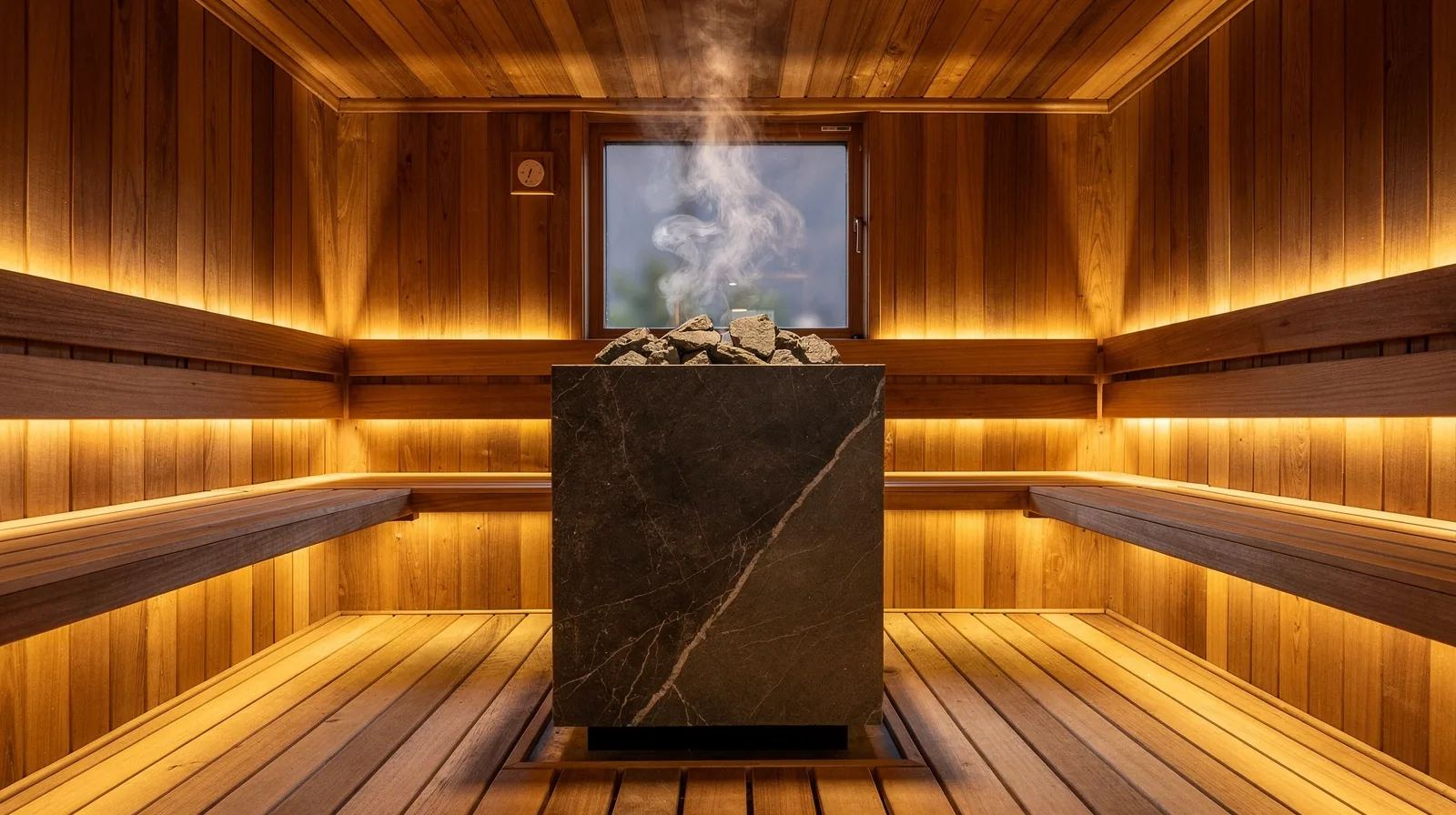
This is exactly where buyers most often hesitate. They look at power in kilowatts, compare prices, but rarely know what they are actually choosing by — because no one has explained that the first question is not “which heater”, but “what kind of experience do I want”. The wrong heater means the wrong sauna, regardless of how well everything else is made.
This guide walks through that decision in the order it should be made: first the heating type, only then the specific heater.
Wood heaterElectric or wood-burning: decide before choosing the model
A wood-burning heater is a genuine project option, particularly relevant for the Austrian market and for users who want firing the sauna to be part of the ritual. It is not interchangeable with an electric heater because it changes operation, planning and everyday use of the entire sauna.
- Ritual and supervision. An electric heater can be regulated precisely and needs less active attention while heating. With a wood heater, lighting and adding fuel become part of the ritual, and the heat source remains manually supervised.
- Utilities and flue route. An electric heater needs a correctly planned power supply. With wood, the heater, flue pipe, chimney route and roof penetration must be designed as one system.
- Safety clearances and combustion air. Combustible elements, protective surfaces and air supply are determined from the selected system and its technical documentation.
- Wood storage, ash and cleaning. Firewood needs a dry place, while the firebox, ash and flue route add regular work. For users who want minimal handling, an electric heater is usually closer to the goal.
- Location and approvals. Feasibility depends on the site, flue route, fire-safety requirements and locally required approvals, so it is confirmed separately for every project.
- Supply and service. On request, KUBIQ can include a CE-marked wood-heater and flue-system solution in the project scope. Availability, spare parts and the service route are checked before confirmation.
A wood-burning heater is not a BIO solution. Controlled humidity requires a compatible electric Combi system; the wood option represents a different way of using the sauna.
Step 01Why the heater is not corrected later
A cladding material can, in the end, be looked at for years and still function. A heater cannot. If the heating type does not match the way you use the sauna, you feel it every time — and it is not solved later without interventions in the electrics, base and ventilation.
That is why the heater is not an item chosen at the end, “whatever is left in the budget”. It is an early decision, because it also shapes everything around it: how the cabin is ventilated, what power supply is needed, and where the benches sit in relation to the heat source.
Step 02First question: what experience do you want?
This is the main decision. Everything else follows from it. Four directions:
- Finnish (classic dry sauna). High temperature, dry air. An occasional water ladle onto the stones creates a short, intense burst of steam (löyly) that quickly settles. If you imagine a “real” traditional sauna — hot and dry, with steam bursts when wanted — this is Finnish.
- BIO (sauna with controlled humidity). Lower temperature, but controlled humidity throughout the session. The experience is gentler, more humid and easier for those who find a classic Finnish sauna too hot. Humidity is not an occasional ladle of water but part of the system — kept consistent through the session.
- Combi. Flexibility: the same sauna can work as a dry Finnish sauna or as BIO with humidity, depending on mood and session. For households where different people prefer different experiences, or when you simply do not want to choose in advance.
- Infrared — an additional layer, not a classic heater. Infrared panels do not heat the air but the body directly, at lower temperatures. They can be installed as an addition to a classic heater, for a gentle, quickly available treatment without waiting for the whole cabin to heat up. It is not a replacement for Finnish/BIO — it is a different heating method that can be combined.
The first and most important thing to know about yourself: do you want dry and hot, humid and gentle, flexibility, or an additional infrared layer.
Step 03How heater output is calculated
Cabin volume is a starting input, not a finished formula. Selection follows the sizing method for the specific heater manufacturer and model.
Internal dimensions, uninsulated surfaces such as glass and stone, build-up, outdoor conditions, ventilation and usage all matter. Two cabins with the same footprint may therefore require different models.
1. Establish effective volume and uninsulated surfaces.
2. Identify models whose technical documentation covers that range.
3. Coordinate the power supply, safety clearances, controls and ventilation.
Step 04Choosing the heater within the type
Once you know the heating type and the rough output range, the next step is choosing the specific heater. There is no universal “best” here — there is aligned and not aligned with your sauna. What needs to align:
- Cabin size and volume. The heater must match the space it heats. An undersized heater for a large cabin means long waiting times; an oversized heater in a small cabin is unnecessary cost and the wrong heat dynamic.
- Usage pattern. Short frequent sessions or long occasional ones? One person or a full cabin? That affects how much heater capacity makes sense and what kind.
- Regulation and control. How much control do you want — simple on/off, or precise temperature control (and humidity, with BIO). The level of control distinguishes heaters just as much as output itself.
HUUM Core Black is KUBIQ's current main starting point for small and mid-size formats, and HUUM Combi where BIO mode is required. The exact model and output are still confirmed from the cabin, use pattern and technical documentation.
Step 05BIO requires a compatible heater
One thing buyers often assume incorrectly: that every heater can work as BIO if water is simply added. It cannot.
BIO means controlled humidity, and that is a system — a heater with integrated humidity regulation and the right controls, not a classic heater that has something added to it. If you want the BIO experience, the heater must be designed for it from the start. That is why the BIO decision is made early (Step 02), not as a later add-on.
The reverse is also true: if you do not need BIO, there is no reason to pay for a heater with that capability.
Step 06When the heater becomes a material too
The heater is not just a heat source — it is also the visual centre of the sauna. One premium option changes both appearance and heat character: cladding the heater in massive stone (soapstone).
Stone heater cladding gives a monolithic, massive appearance and a softer, longer-lasting heat — the stone stores heat and releases it gradually. It is an optional upgrade, a more expensive option for projects that specifically want that feeling and look, not a standard execution.
Interior materials and how they work with the heater are covered in more detail in the separate guide to sauna interiors.
Step 07What buyers most often assume incorrectly
- “More output = a better sauna.” No. Output is calculated from cabin volume (Step 03) and corrected for glass. An oversized heater is not an advantage — it creates the wrong dynamic and unnecessary cost.
- “Infrared is the same as Finnish, just more modern.” No. Infrared heats the body directly at a lower temperature; Finnish heats the air and stones. They are two different experiences — one does not replace the other.
- “Every heater can be BIO.” No. BIO requires a heater designed for controlled humidity (Step 04).
- “I choose the heater at the end.” The opposite — the heater is an early decision because it shapes ventilation, power supply and cabin layout.
Step 08How KUBIQ guides the heater choice
The order is always the same:
1. Experience — dry and hot (Finnish), humid and gentle (BIO), flexible (combi), or an additional infrared layer. This sets the type. 2. Heater aligned with the cabin — size, usage pattern, desired level of regulation. 3. Execution around the heater — ventilation, safety clearances, possible stone cladding as a premium option.
We do not choose the heater by the number on the specification sheet or by price, but by what kind of sauna you actually want to use. If a choice does not suit your cabin or usage pattern — we will say so and suggest what makes sense.